Storytelling
The main focus is not on storytelling, but we will include some background story parts.
- Hero, who has desire.
- Major Dom has the desire to travel the universe, together with his friend Moot.
- Event, which creates disarray and problems, which also interferes with obtaining the desire.
- Our Heroes crash into a foreign planet where they encounter native enemies.
- Hero overcoming the problem.
- They need to collect the spaceship spare parts to rebuild it. On the way, they need to fight enemies and find they way out from the planet.
- Mission failed?
- If the players do not complete the level by collecting the spare parts, the "Mission" fails.
- Reversal of Fortune
- If they can complete the level by collecting the spare parts, they can find their way out.
- Greater Problems with greater risks.
- Completed one Level? Another Level appears on the map, which is has more complex riddles to solve.
- One last problem with most risk of all.
- Having all spaceship parts together for rebuilding it.
- The hero must resolve the final problem.
- Rebuild the spaceship and escape the foreign planet.
- Object of desire
- Final Goal of our Heroes is to collect all spaceship parts, fix the spaceship and to fly back home.
Design Practice Questions
How do the actions that you make available to the player work with the story in your game such that the story remains credible, coherent, and dramatically meaningful?
- The players can use the characters to collect spaceship fragments, which they will use to rebuild the spacecraft in the end (when they completed every level). That appears dramatically meaningful because they cannot leave the planet without their space ship and they cannot rebuild it without the fragments.
How will you design your gameplay to be sure that the player does not experience so much randomness or repetition that it harms the dramatic tension of your story?
- Every level with same design themes are build with the same structures and elements. That brings consistency, but also different background music, collectibles, fragments and platforms in different themes with it.
- Every game world also brings a different gravity with it.
- In conclusion, every level will be unique in it's plattform structure, which brings up a lots of curiosity and adventures feelings. But the platforms in some levels will look the same.
Will the story in your game be linear or nonlinear?
- The story will be linear. This makes the most sense in a jump and run multiplayer platformer game.
- The players cannot change the game's future with their events. If the players do not collect the spaceship fragments, he will have to play the level all over again to collect it.
If your story is nonlinear, will the story branch or fold back? What kinds of things will cause it to branch: challenges, choices, or both? Will you allow deferred or cumulative influences, or will all influences be immediate?
- NOT non-linear
If the story folds back, how many inevitable events will it have? What will they be like?
- NOT non-linear
How many endings will your story have? How does each ending reflect the player’s play and/or choices throughout the game?
- The game will have two endings:
- Collected all spaceship fragments, rebuilt the spaceship and escape from the foreign planet.
- Players did not collect all spaceship fragments, which means that they were not able to rebuild the spaceship and cannot leave the planet. They will have to complete every level by collecting the spaceship fragments.
- The game will have two endings:
What will be the size of your game’s granularity? How and when are narrative events interwoven with game events and player actions?
- Narrative events like showing the characters rebuilding the space craft are interwoven with the end of each level. Players can find cutscenes showing the progress of rebuilding it.
- Players can also find a small foreign alien on their way, distributed everywhere in the level. He tells the players about the character's background history, gives them tips about what to do next (in the level sequence) and tells stories/ lore on the way to each level completion.
What mechanism will you use to advance the plot? Travel, events, time, or some combination?
- The whole story is about travelling the universe. In addition the characters have to travel the game world (foreign planet) to find the spaceship fragments. Events like fighting enemies, shifting gravity and rebuilding the spaceship step by step are part of the events.
- Time also plays a role. By solving levels in a shorter time, the players will be able to gain extra points. They can use them to buy gadgets and more. If they do not reach the level's end in a pre-defined time, they lose and have to start the level from the beginning.
- Health plays a very important role. If the characters fight enemies and get hit, they lose one of their three lives.
- If one character dies, the other character can revitalise him. Small interactions like speech bubbles in the health and time bar can help recognizing it.
Can the story begin at the beginning of the game, or would the game benefit from a prologue as well?
- The game uses a prologue in form of a cutscene in the beginning. It explains the story of how the two strange galactic friends ended up stranded on the alien planet.
- After each completed level their will be another cutscene, which explains the next steps in the game or shows the current status of the reconstruction of the spaceship.
- In conclusion the story begins before the actual game.
Will the game include narrative (that is, noninteractive) material? What role will it play — an introduction, mission briefing, transitional material, a conclusion, or character definition? Is the narrative essential for the player to understand and play the game?
- The narrative material will be the noninteractive cutscenes, at which the players, for example, see their characters having a conversation with each other or the storytelling alien. With these cutscenes and the storytelling alien the players will learn about the characters, which is used as the 'character definition'.
- The cutscenes in the end of each completed level is considered a 'mission briefing' and can be used as a 'level-transition'.
- The end scene, where the spaceship is rebuilt completely, is used as the conclusion.
What form will the narrative material take? Pages in the manual? Scrolling text in the program? Movies? Cut-scenes? Voice-over narration? Monologues by characters?
- Dialogues and monologues in cutscenes and the storyteller alien, which speaks (shows text) to the characters are used as narrative material.
- Small extra: speech bubbles in the time and health bar are used for small interactions with the players and immerse them more and more into the gameplay.
What actions might the player take that are story actions but not efforts to overcome challenges? Conversations? Construction? Exploration?
- The player cannot create storylines for the game. The only way having essential conversations for the plot, is by looking at the cutscenes.
Will the game include scripted conversations? Between the player and which characters? For what purpose?
- Yes. The scripted conversations can be found in the cutscenes. You can find monologues, dialogues (between Moot, Major Dom, aliens on planet) and small story related/ building actions in each cutscene.
Will the story be multipart? If so, how will the plot lines be handled: as an unlimited series, a limited series, or a serial?
- Each planet (/game world) brings its own unique story, because each planet brings different conditions in gravity, planet dwellers, time and design.
- The plot lines will be handled as unlimited in general but limited for each game world. That does not restrict us to create more game worlds.
Immersion
- Players will feel deeply involved in strategic and tactical gameplay by watching story cutscenes, having speech bubbles as reminders for time and health and trying to complete every level to watch the next cutscene.
- They will feel like they would build up the spaceship on their own.
Events
- Narrative events
- Cutscenes in between.
- In-Game: Storytelling foreign alien which talks to the characters (text about e.g., background story, side information, tipps and tricks to solve the tasks) on it.
- Computed events: No non-linear computed events.
- Player events: These do not change any story lines.
- Narrative events
Key Design Goals
Overall Importance of the Story.
- The story is not the most important part of the game, but it helps to immerse the players into the game and feel picked up at their current conditions.
Function of the Story in the Experience.
- Immersion of players in the game play.
- Theoretical information about the characters, story and tasks.
Degree of Well-Formedness.
- The storyline is well-formed, because it contains no random events. There can be repetitive events. Repetitions let the players think, that they know what comes next. This can create surprise effects, by breaking the repetition and implementing something new.
Emotional Goals for the Story.
- The two players play together as a team, which means that their will be the emotional goal to solve the tasks together with your partner and help your partner in need.
- In most situations family members, coworkers/ colleagues or friends will be playing the game together. This shows the relationship that has been built up already between the two players.
Storyteller Alien
- This alien is a native citizen from the foreign planet, but was bullied and rejected by the others because of his big eyes. Now he helps 'Strange Galactic Friends' players to complete levels successfully.
Idle Animation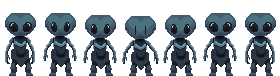
In-Game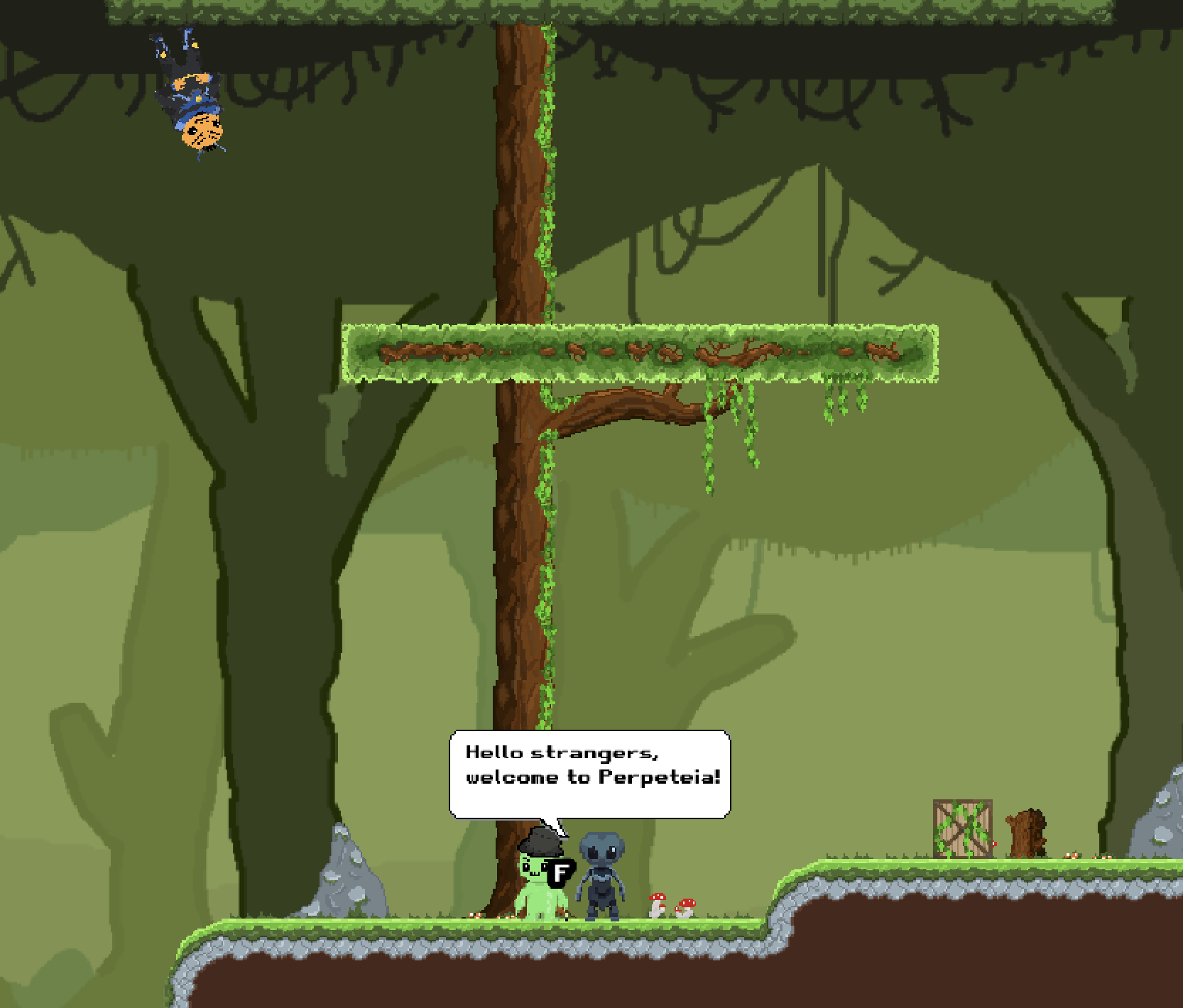
Monologues and Dialogues - told by the Storyteller Alien
Part 1:
Alien:
What a beautiful day on Peripéteia to relax and have a tea.
Oh no! A big fireball in the sky! What just happened?
Something is falling out of the sky.
I think it’s some kind of spaceship.
It looks like it crashed near here!
I hope nobody got hurt.
Let’s get a better look!
Part 2:
Alien:
Indeed, it is a spaceship. It looks damaged.
It seems to be a ship from a Spaceranger Unit.
A lot of parts are missing.
The uncontrolled fall through our atmosphere dismantled the spaceship.
Now, the parts are scattered all over Perpeteia.
Look!
There are survivors!
It seems they’re okay.
His Uniform looks like  a Rakianian Spaceranger.
I’ve read a lot about the famous Spacerangers.
They are an elite unit from Planet Ra.
Its inhabitants, called Rakianians, are the most skilled and advanced race in our universe.
But they are also highly in demand for resources and known for exploiting other planets.

But who is this little green guy?
And why is he wearing this weird hat?

Let’s talk to them.
Level 0 (Tutorial):
Alien:
Hello strangers, welcome to Perpeteia!
It looks like you had a rough landing.
Are you hurt?

Good to hear you’re fine.
Alien:
Ah Your name is Major Dom...
...I’ve heard of you, Major Dom...
...you are a well-known Spaceranger from Planet Ra.

Oh .. you were on an exploration mission...
...to find new planets and resources...
... to exploit i would guess?...
... your race is famous for that!!...

...but your spaceship ran out of fuel...
...and you "landed" here.
Alien:
But I don’t know what kind of creature your little friend is...
The only sound it can make is "I am moot"...
Ah, you found it on a lonely planet during a tank stop.
And why the funny-looking hat?
Alien:
Your spaceship looks badly damaged. Parts are missing.
I saw the crash.
The parts fell all over the planet.
Alien:
If you can find them and repair the ship...
Alien:
No worries, my friends! I will help you get back home.
Alien:
Unfortunately, most of the inhabitants are not very friendly.
They will keep the spaceship parts hidden from you.
Alien:
Also, there are a lot of dangerous cliffs you could fall down.
And keep in mind, the gravity on this planet works differently.
Alien:
The locals like to keep their treasures behind locked doors.
But I know how to open them...
You need to find ways to activate these plates.
I recommend using these boxes you can find everywhere...
Alien:
But let’s start and find the parts.
Alien:
The jungle in this area is very beautiful, isn’t it?
But as you can see, our gravity is a little weird...
You’ll need to use your gravity skill.
Here, you can find your first spaceship part.
But how to access it? That’s for you to figure out.
Level 1:
Feeling at home already?
Do you love the forests as much as I do?
I think I saw another part of your ship near here.
Be careful! There are a lot of dangerous holes!
Level 2:
Here, you can find another part...
It’s getting harder now. This area is full of hills and holes.
You and you slimey little friend will find a way... I believe in you!
Level 3 (Level Flappy Bird):
Sometimes the world seems turned around.
Use your so far established shifting skills and mention the tree stumps.
Level 4:
Peripéteia also has a lot of caves, as you can see.
Not as beatiful and very dangerous!!!
The forests are a walk in the park compared to this!
But you’re a Spaceranger. You’ve been to all the dangerous places in the universe.
Level 5:
You think your race is smart, Rakianer?
But look at these pressure plates...
I’m sure they’re a challenge even for you.
In the end another spaceship part is waiting for you...
Level 6:
Ah, back in the beautiful forests.
This is how a planet looks before your race arrives and exploits its resources.
Maybe that’s also why the inhabitants here aren’t too friendly...
But i know you are a good guy .. so i will help you getting back home
Maybe you can make a change and stop exploiting other races.
Level 7:
Missing home?
Your Spaceship is almost good to go...
Just one last part is missing.. you can find it here...
But take care its not easy to reach.
Epilogue:
The heroes found all the parts!
Last screw is tightened.
The spaceship is repaired.
The engines are running again.
It’s time to fly back home.
(“Thank you for your help!” says Mayor Dom.
Mayor Doom and Moot are waving goodbye.
The ship takes off.
They are flying into the universe, off to new adventures...)

Finally, I can go back to relaxing and having my tea.